Open Source Contributions in 2026
Below are changes merged in 2026 and active pull requests I’ve submitted to open-source projects this year. Dates show when merged changes landed or when active contributions were submitted.
-
Merged
PR #1108tune— Clearer printing for control objectsA small quality-of-life addition to help out a library I've used a lot. Added dedicated print methods that use
clito show settings such as verbosity, parallel processing, prediction storage, and event levels as a readable list. This makes control objects (and their defaults) faster to inspect. -
Merged
PR #135finetune— Preserve resample weights in racing methodsLast year I contributed fold weights to
tuneto help enable variable-sized folds. While testing them with racing methods, I noticed thatrandomize_resamples()did not carry them correctly. This PR fixed that. -
Merged
PR #438arviz-stats— Add bivariate histogram and hexbin statisticsAdded public
histogram2d()andhexbin()functions with support for NumPy, xarray, batched computation, weights, density normalization, explicit extents, and nonfinite samples. This gives every ArviZ plotting backend the same binning logic and the edges or centers needed to draw matching binned 2D distributions. -
Merged
PR #568arviz-plots— Add bivariate histograms to pair plotsAdded the rectangular and hexagonal bivariate histograms created in the above
arviz-statscontribution toplot_pair()andplot_pair_focus(). This gives users binned alternatives to scatter plots for dense pairwise distributions. -
Merged
PR #442arviz-stats— Support short chains in nested R-hatMade the minimum draw requirement for
rhat_nested()depend on the estimator, allowing one draw per chain for the identity method and two for split-based methods (while handling several short-chain edge cases). This supports GPU-friendly sampling workflows that run many short chains in parallel. The previous shared validation did not support that use case, returningnanfor valid inputs with fewer than four draws. -
Merged
PR #8497pymc— Fix LKJ sampling and log densitiesWhile working on covariance terms in Bambi, I found three discrepancies in PyMC's LKJ distributions, which are used to model correlation matrices. This PR corrected the sampling algorithm, added a missing Jacobian term to
LKJCorr's log density, and fixed normalization errors. These changes address incorrect forward draws and log densities that can affect posterior inference. Also clarified how to recover the correlation matrix from the returned Cholesky factor. -
Merged
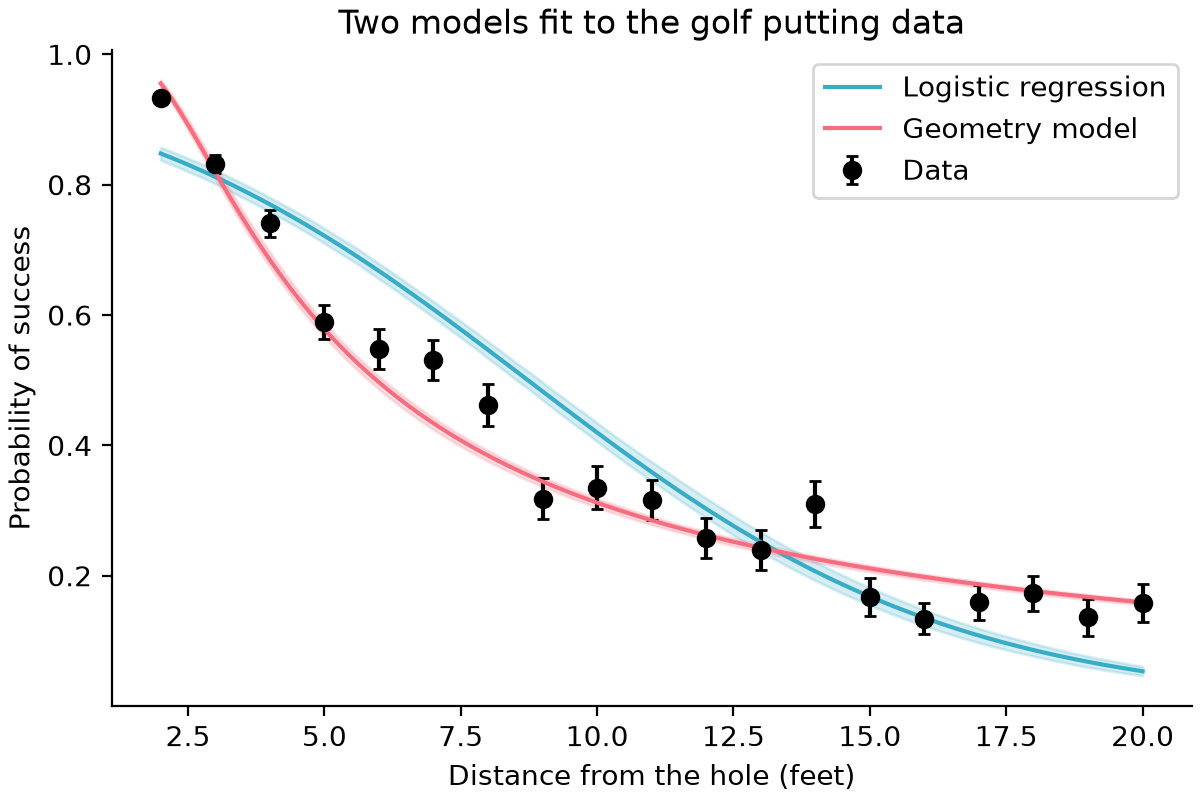
PR #1006bambi— Add nonlinear formulasAdded nonlinear expressions for likelihood parent parameters while retaining ordinary Bambi formulas for each named parameter, including common, group-specific, and offset terms. This brings nonlinear models into Bambi's existing formula, prior, prediction, and link machinery, enabling a new class of models. One example is the classic Gelman golf model, which I reproduced end to end.
Cite This Post
@misc{burch2026open-source-contributions,
  author       = {Tyler James Burch},
  title        = {Open Source Contributions in 2026},
  year         = {2026},
  month        = {September},
  howpublished = {\url{https://tylerjamesburch.com/blog/open-source/open-source-contributions}},
}